MEABNOTE: I’ll be going on a blogging vacation at the end of the year and there won’t be any daily posts between December 18 and December 31. After that, we’ll ring in the new year on January 1, 2025 with the 2024 version of Travel Hacking as Told by GIFs though, so no need to be up in arms, but I guess it’s ok if you’re up in legs.
Chase: You’ve got 30 days to redeem or transfer your miles
Capital One: Your miles are immediately redeemed at 0.5 cents per mile
American Express: Your points are forfeited at the end of the business day
Citi: Your points are forfeited at the end of the business day
Wells Fargo: Your points are forfeited immediately
With American Express and Citi, if you’re quick at noticing the shutdown, you can call their redemption departments immediately and likely get your points redeemed or transferred out. The phone numbers for each:
American Express Membership Rewards: 800-297-3726
Citi ThankYou Points: 800-842-6596
If your points are forfeited, you may be able to mediate or litigate to get your points back, but of course I’m not a lawyer and I’m definitely not your lawyer.
Good luck and stay safe!
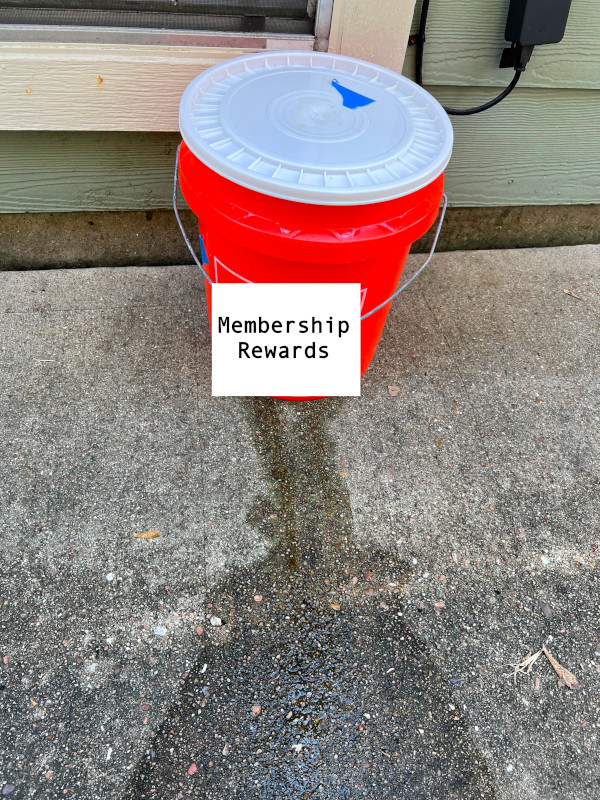
Captured: The moment a Membership Rewards bucket drains.
I have two favorite old-school niche travel blogs, TravelBloggerBuzz and The Free-quent Flyer. One of the interesting insights from the latter, from way back in 2016, was about manufacturing small transactions with Plastiq. At the time, Plastiq’s transaction fees were percentage based and didn’t have minimums so you could send a very small payment and pay a $0.01 fee for it, a perfect way to manufacture transactions.
Plastiq fixed the small payment nearly zero-fee transaction years ago, but Gideon at The Free-quent Flyer set up scheduled transactions through the year 2026 before the minimums kicked-in and those transactions are still going under the old fee structure.
There’s a lesson here, especially because we just had another niche payment method go away this week: Whenever you can schedule your games to continue into the future, you probably should find a way to do so. If you played your cards right, you may have years of shenanigans ahead of you even after something dies.
Good luck, and remember: I’m only cryptic and Machiavellian cause I care.
Warning: You can go too far with manufacturing transactions, but on the other hand I never saw a Plastiq hat.
This one is safe for anyone to use, potentially unlike the one made public last week which was dubious at best and err, scary at worst. Why was that one dubious? It was a manufactured link specifically constructed with two contradicting offers that happened to pass through the application system in an unintended way. Side-note: That fact that this link is dubious still isn’t noted on other blogs, hopefully because they just don’t know. Always know the province of links before diving in. (Thanks to reb702)
I got approximately 25,000 Rapid Rewards points back by grooming by existing bookings, though most of those existing bookings are backup flights so the expectation value for my actual cost is lower than 40%.
There’s a ton of economy space at 15,000 miles in this month’s drop, more than I’ve ever seen in-fact. Discount business class space is almost non-existent this year and barely-existent next year.
If you’re banned by Citi and not by Barclays, I think getting a Barclays AA card now is your best chance to get back with Citi with minimal hassle; of all banks with bad IT and poor practices around closures and blocklists, Citi ranks first. At least Citi ranks best at something right? If you can count on anything in churning, it’s that #CitiGonnaCiti and the most logical, simple thing will never be the one that happens.
The Coase theorem, winner of the just made up MEAB award for “best theorem with the most obtuse Wikipedia description possible” award, says essentially that the value of something can be measured by what you’d have to pay someone to give it up. (Editor’s note: Take a couple of minutes and read the first paragraph of the linked Wikipedia article, wowza that’s bad!)
Example
Let’s illustrate with America’s favorite fruit, bananas. How much are bananas worth in your life? Would you give them up forever if I paid you $1? What if I paid you $10,000, or maybe even $40,000? The smallest number that causes you to swear off bananas forever is, according to the Coase theorem, their total worth.
Making it Real
When assessing how risky a manufactured spend stunt is, the Coase theorem gives a concrete way to assess whether or not one should attempt the stunt, knowing that it might lead to a bank shutdown.
Let’s say, for funzies, that there’s an opportunity to earn 7-8x transferrable points for a cost of ~3%, with effectively unlimited capacity (yes, this has happened, and yes, more than once; no, sorry, I can’t share a play like that right now). If a manufactured spender went as hard as possible with 8x earn on 3% cost, most banks or credit unions would axe that account within weeks or months, and the relationship with that bank would likely also be fried for at least 7-10 years if not forever.
So, can that manufactured spender earn enough in weeks or months to make the play worth frying the relationship? If yes, LFG I guess.
A Case Study
What’s MEAB’s Coase theorem valuation for a few things?
American Express: $1,000,000+ (or maybe less after October 1)
– Hilton Aspire (NLL, new): 175,000 points after $6,000 spend in six months – Hilton Surpass NLL: 130,000 points + Free Night Certificate after $3,000 spend in six months – Hilton Honors NLL: 70,000 points + Free Night Certificate after $2,000 spend in six months
Remember that contrary to churning wisdom, AmEx NLL links don’t govern whether or not you’re going to get a bonus. Instead, the pop-up does. NLL links are special though because they’re less likely to give a pop-up. Also note that sometimes you can get around a pop-up with trickery, but only sometimes.
– Transcon flights pricing at 9k miles – Short-haul to Mexico pricing at 4.5k miles – Hawaii flights pricing at 9k miles
There’s lots of space available August through October, and some availability in November before Thanksgiving.
American Express has targeted offers for opening new business checking accounts through July 31. Both require the funds to be deposited within 30 days and held for another 60. You also need five eligible transactions, which for me means five scheduled ACHs of $1.00:
There are two common fallacies that many churners share: (1) Raisin day doesn’t exist, and (2) there’s no way to get this bonus multiple times. (Thanks to DoC)
Behind most FinTechs is one of a handful of partner banks, common ones include: Evolve, Stearns, Sutton, Cross River, and Celtic, but there are others. Somewhere between an average FinTech and a partner bank you’ll sometimes also find a Banking-as-a-Service player, and there are even fewer of those. Common BaaS names that you may have heard of are Solaris Bank, Green Dot, and Solid.
NOTE: In case you’re wondering, Banking-as-a-Service is nicknamed BaaS because the finance industry often lacks creativity and tries to hide it with focus group generated names designed by committee to appeal to millennials on paper, but the names they arrive at don’t actually appeal to millennials in practice.
A few days ago though, TabaPay announced that it was terminating its purchase agreement of Synapse because of issues with TabaPay’s partner bank, Evolve, funding accounts related to the transaction. Of course, just like a reality TV show, Evolve says that it’s not true because of course they did. Then, Evolve froze the assets of multiple FinTechs built on the Synapse platform because of course they also did that.
After the agreement was called off on Tuesday, a bankruptcy judge went on record to say that up to 20 million FinTech depositors are at risk due to Synapse’s bankruptcy and the failed deal. What does at risk here mean? It’s not fully clear, because typically a BaaS’s partner bank holds custodial accounts for customers and those are FDIC insured, but if they’re frozen and you can’t withdraw them, then FDIC insurance doesn’t mean anything for access to your cash. Additionally, depending on the financial structure of the custodial account, FDIC insurance may be insufficient too.
The Effect on FinTechs
Since Evolve froze FinTech accounts worth $114,000,000 related to Synapse this week, we’ve seen ripples through multiple FinTechs including Juno and Yotta, each of which have had their customers’ accounts frozen by Evolve. My personal, uninformed opinion after watching the Silicon Valley Bank drama is that the federal government won’t let FinTech users lose this money, but of course my opinion tends to have no bearing on reality.
The Advice you didn’t Ask For
Juno had been an interesting tool for manufactured spend at multiple points in the past, but that’s changed recently even without the Synapse drama. Some manufactured spenders still have significant funds on deposit that’s no longer accessible though, and there are indications of issues at other FinTechs too, including but not limited to Yotta. So, while the Miles Earn and Burn way is “always be probing”, I’d sit back on probing any FinTechs that might be involved with Synapse for the time being.
Good luck out there friends!
The finance community’s premier product and industry name committee.