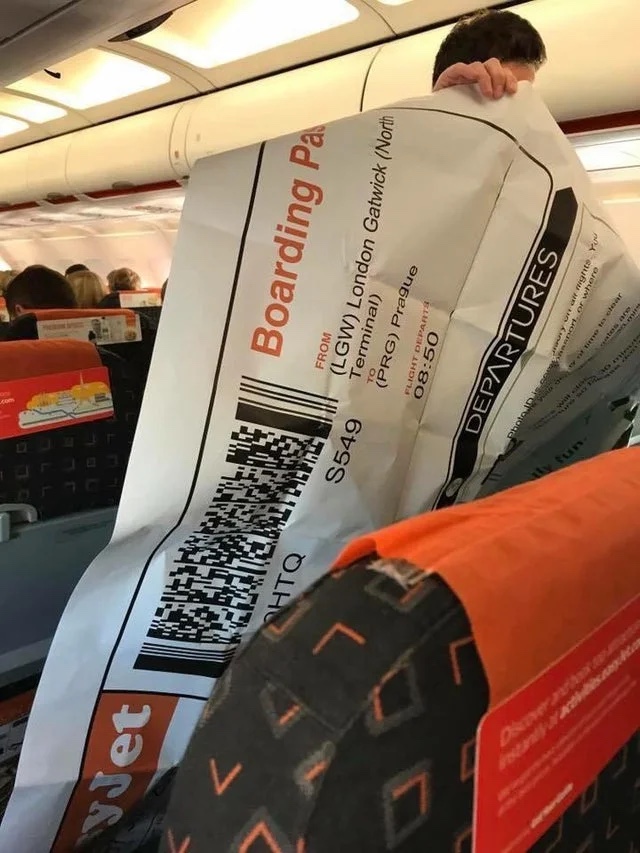
Call me out of touch, but I don’t use airline electronic boarding passes on my phone unless I’m really, really late and don’t have time to get one. Why? When I use a paper ticket:
The battery doesn’t die on my boarding pass
I don’t need to worry about the brightness setting on my boarding pass
I don’t need to worry about FaceID, TouchID, or a passcode to unlock my boarding pass
When entering a lounge or asking for help at the gate, I don’t need to hand over my phone
I have a place to put my checked baggage claim stickers (though I rarely actually check a bag)
I can still use my phone while waiting for my boarding group to be called instead of constantly fiddling with the screen to prevent it from dimming or locking at an in-opportune time
As we’ve discussed before in multiple instances, getting eyes an account ripe with shenanigans is a good path to a shutdown of at least that account, and probably all accounts held at an institution. So you should place a high priority on avoiding the prying eyes of an analyst when your account is filled with gift card purchases, payments by phone, money order deposits, anonymous payments, or anything else that banks don’t like in bulk.
Fraud Alerts
Perhaps the quickest path to an analyst from a bank’s fraud team looking at your account to do nothing when you get a fraud alert. That’s because when a fraud alert is generated, banks will put your account in a queue for manual review and (hopefully) notify you about the alert via a push-notification, text message, or email. Good banks will typically service that queue within 24 hours, while other banks like, I don’t know, Citi, can take up to a week to get through that queue. When an analyst pulls your account out of the queue, they may not like what they see and give you the axe.
If, however, you preemptively clear an alert, it’s almost always removed from the queue and no analyst looks at your account. Even better, fraud detection algorithms are usually trainable and a cleared alert means it’s less likely that you’ll see another alert in the future.
So when you get a fraud-alert, the action item is obvious: Don’t procrastinate. Just clear it as quickly as possible to keep anyone from looking at your account, either by responding to the alert or by calling the bank’s fraud line and hopefully doing it with an automated system. Bonus tip: if you can’t clear an alert with an automated system, calling outside of normal US working hours is more likely to get you to a customer service representative that lives in another country and is generally more apathetic about what happens in an account.
MEAB Scaremongering
So that we can appropriately calibrate urgency here: There’s buying a gift card or two and depositing a money order once a month, and then there’s going ham. If you’re not in that latter category I wouldn’t worry too much and just keep doing what you’ve always done. If not though, keep the bank’s analysts out of your accounts!
A captured screen shot from Citi’s soon to be released fraud alert verification system.
Major US and world airlines all have some variation of a “flat tire” rule, so named because United Express gets flat tires nearly daily [citation needed]. The gist of these rules is that if you’re late to the airport, miss a flight, and show-up within an hour or two after departure, the airline will reaccommodate you on another flight on a space available basis.
Well, gamers gonna game, so we can take advantage of these rules.
The Game
Let’s say that you’ve booked an evening IAH-LAX-DEN versus a direct IAH-DEN flight because it was a few hundred dollars cheaper than the direct IAH-DEN flight that leaves an hour later, but you’d really still like to take the direct flight. You can see where this is going, right? As long as there’s space on that direct flight, you can probably “miss” the IAH-LAX flight time by a few minutes and be rebooked on the direct IAH-DEN flight under the flat tire rule. Why did I choose this example you ask? Uh, let’s keep it at “because reasons”.
Aside from switching to a direct routing, there are other creative reasons to do this:
To extend your time in a city (especially useful when you’re booked on the last flight out for the day)
To let you sleep in past that early morning departure
To avoid flying on a CRJ-200
To miss the last direct flight of the day and be rebooked with a connection, only to backdoor hidden-city ticket and leave the airport at the connection
Because upgrade chances on another flight are much better
Airline Rules
When do you have to show up at the airport to qualify for the flat rule?
AA: 2 hours after originally scheduled departure
Delta: No official policy, but generally anything within two hours is fine
United: No official policy, but generally anything within an hour is fine
Southwest: 2 hours after originally scheduled departure
Of course, there’s a good shot that if you call in to the airline’s customer service department after your missed departure, they’ll handle everything and you won’t have to go to the airport at all, but ymmv.
Caveats
Obviously playing these games could backfire in several ways, for example: flights are sold out for a few days and you’re stuck, you might end up in a middle seat, you may be routed through Lubbock, TX, and so on. The best defense to problems like these is to know what flight availability and seat-maps look like after your scheduled departure time, so make sure to tilt the odds in your favor.
Happy flying!
Another form of Russian Roulette: Taking your originally scheduled flight on an ERJ-145.
Editors note: Sometimes I can’t help but get academic and nerdy; but stick with me, the results are good. There’s good stuff in the academic community, and we can apply it directly to your travel to make it better. I don’t know of anyone else doing anything like this, so here we are.
Introduction
There’s an interesting statistics thought experiment that comes up in academia called The Monty Hall problem. The gist of the problem is:
You have three doors with something behind each door, 2 doors have something lame and 1 has something great
You choose a door but don’t yet know the results
The game-master tells you that one of the doors you didn’t pick has a lame prize, and shows you which door
Ok, so there are two doors left: The one you picked and the other door. Unless you’re trained in statistics, you probably think you’ve got a 50% chance that your door has the great prize and a 50% chance that the other door has the great prize, because there are only two left. But, the math behind the Monty Hall problem says that your door is 33% likely at that point to have the great prize, and 67% likely to have the lame prize. (See the Wikipedia page for the math behind the result if you’re interested.) In other words, the other choice is now twice as likely to be the best choice, so choose it if you can!
Applying This Result to Flights
We can apply this result to airline delays with some fuzzy mapping: one door is your on-time departure (your original choice, a delayed flight might be un-delayed and is thus still an option), one door is your delayed departure, and the third door is a an alternate flight.
Based on the math behind the Monty Hall problem, if you’re told that your original flight is delayed, then switching to an alternate flight is more likely to get you to your destination without a late arrival; twice as likely all things being equal (which they’re not). If you’ve ever experienced rolling delays on your original flight, you’ve got some intuitive feel that switching to another flight is probably less likely to lead to an arrival delay too.
Making it Real
There’s a problem with that analysis though: It’s highly unlikely that you’ve got an alternative flight to switch to that leaves at the same time as your original flight. So, to make this actionable for real-world scenarios, we’ve got to factor average delay time into our analysis. To do that, I downloaded the last 12 months worth US airline flight on-time data for a deeper-drive.
First, let’s assume that your airline posts a delay of 45 minutes or longer. In the last year, this is what each major carrier’s average arrival delay looked like:
Operating Airline
Average Arrival Delay, August 2021-July 2022 (For Departure Delay ≥ 45 Minutes)
AA
2 hours 13 minutes
Alaska
1 hour 36 minutes
Delta
2 hours 1 minute
Frontier
1 hour 51 minutes
JetBlue
2 hours 17 minutes
Spirit
1 hour 49 minutes
SkyWest
2 hours 21 minutes
Southwest
1 hour 23 minutes
United
1 hour 53 minutes
So when your airline posts a delay of at least 45 minutes, if you’ve got an alternate flight that leaves within an hour and a half or so, you should switch to that alternate flight (especially if your flight is operated by SkyWest).
Next, let’s assume your airline posts a delay of 90 minutes. In the last year, you’re looking at an average arrival delay of:
Operating Airline
Average Arrival Delay, August 2021-July 2022 (For Departure Delay ≥ 90 Minutes)
AA
3 hours 23 minutes
Alaska
2 hours 35 minutes
Delta
3 hours 19 minute
JetBlue
2 hours 54 minutes
Frontier
2 hours 54 minutes
Spirit
2 hours 49 minutes
SkyWest
3 hours 36 minutes
Southwest
2 hours 19 minutes
United
2 hours 59 minutes
The conclusion from this one: If your departure delay is posted as 90 minutes or later, switch to an alternative if you can get one in the next three hours or so.
Finally, let’s look at the data by major airports instead of by airline, sorted by the total number of delayed flights (these major airports are also the airports most likely have alternative flights):
Airport
Average Arrival Delay, August 2021-July 2022 (For Departure Delay ≥ 90 Minutes)
DEN
1 hour 42 minutes
ORD
1 hour 52 minutes
DFW
1 hour 49 minutes
ATL
1 hour 43 minutes
MCO
1 hour 50 minutes
CLT
1 hour 42 minutes
LAS
1 hour 37 minutes
LAX
1 hour 50 minutes
PHX
1 hour 40 minutes
The statistics aren’t very different for other major (top 50) US airports. However delays are much more likely to extend beyond two hours at small airports, where you likely don’t have another option anyway.
And for my last analysis, I looked at the reason for the delay when it was available. In cases where the data is available, the longest delays are caused by (from the biggest contributor to the smallest):
When you start manufactured spending, the biggest limiting factor for scale is usually your lack of knowledge and experience in the field. Once you learn a few techniques and find the right plays, the limiting factor will probably turn into your float; that is, outstanding available cash and credit line balances.
You know you’ve hit float as a limiting factor when you immediately want to use a deposit that shows as “available” in your bank account on Tuesday morning to pay down a balance on your credit card, so that you can go spend and repeat the cycle on Tuesday afternoon. Listen Trigger, I know that in the modern world of Zelle, ACHs, and other electronic money transfers, it sure looks like money is available to pay a credit card the moment the bank tells you it is. The problem though, is that the bank is lying to you.
Cleared Funds
Even though a bank shows your balance as available and lets you send it away with a few clicks, it’s really not fully available because banks are still living in a technology world that’s a decade behind our own at best. Your electronic or money order deposits aren’t actually cleared funds (definitively in the accounts of the receiving bank) when most banks make them available to you. When are they actually cleared funds?
ACH, Zelle, and other electronic deposits: Three business days
Wires: Up to one business day
Cashiers checks and money orders: One business day
There’s an additional rub: there are different cut-off times depending on the bank, how large its assets are, and the type of transaction, but typically it’s safe to assume that if you make a deposit or receive an electronic transfer after 2PM Eastern, you’ve missed the bank’s business day and a deposit after that time is effectively no different than a deposit the next morning.
Kiting and Shutdowns
Kiting is floating money in-and-out before it clears, intentionally knowing that ultimately it won’t clear and running away with the funds before the bank knows what’s happened. Kiting is illegal and if all that happens from actual kiting is a bank shutdown, you’re really lucky. But a manufactured spender paying their credit line the moment deposits are available isn’t kiting because the funds will clear, so what’s the problem?
Easy, when it looks like you’re potentially kiting, a bank’s risk department will take a look at your accounts and almost certainly shut you down. It doesn’t matter if you weren’t actually kiting and your deposits all eventually clear, the bank still sees major movement before money is cleared as a big risk, and when you’ve scaled your manufactured spend that risk eventually becomes untenable and you’ll get the axe, “out of an abundance of caution“.
How does one stay alive? Be aware of the timelines for cleared funds, and don’t move money out of your bank account before funds are cleared, even if the bank shows your balance as available and lets you move money out the same day. Stay alive friends!
Citi is its own kind of special when it comes to shutdown triggers, and we should chat about Citi shutdowns because it seems to be on our collective conscience right now:
Unlike most other banks, Citi hasn’t automated its rules for shutdowns and you can’t get around most of its automation with slow ramp-up and similar gaming. Instead, Citi’s algorithms for everything except spend patterns are largely rigid and exclusively for flagging accounts for human analysis. It’s always up to a human to determine whether or not your account stays alive once you’ve been flagged.
The Impact
Citi’s human analysis means that when you look surface deep you’ll find certain conundrums. My favorite is that some churners report cycling Citi credit lines without any issues, and you’ll find other reports of shutdowns after accidentally cycling credit lines by a few hundred dollars. A similar story comes up with bill pay services like CheckFreePay, and the list goes on.
When you dig a bit deeper with the knowledge that Citi shutdowns are human based, you’ll find that all of these reports are probably true. The real shutdown trigger at Citi is if your transactions look suspicious at a glance when an analyst examines your account. Repeated $200 payments don’t look normal and will probably lead to a shutdown, but four invoice payments to a legitimate business with one-to-two sizable payments in the middle is probably fine even if credit lines are cycled.
Avoiding Shutdowns
Thus, to avoid shutdowns with Citi, you’ve got two options, but only one of them is needed to keep you alive:
Don’t get an analyst looking at your account
Don’t have a strange looking transaction history
Personally, I shoot for the former always, and the latter to the extent possible. Either way you’ve got options.
Good luck!
Inside view of the server responsible for Citi’s suspicious credit card behavior algorithms.
That list isn’t comprehensive either, other deals have been lost in July too. Fortunately July has also brought a hand-full of old deals back from the dead, including some hinted at just yesterday, the week before, or a few weeks ago. What’s the lesson here? Deals often don’t stay dead. When it’s time to get out there and probe, spend a bit of time looking for deals that want to attack Brad Pitt. They’re out there, and they’re often very fruitful.
The greater manufactured spend and churning collective has been slowly twirling toward a land of confusion with American Express application rules, especially related to no-lifetime language (NLL) applications. Let’s clear it all up: Lifetime language and a popup during a new credit card application aren’t the same thing, and they don’t matter in the same ways.
(No-)Lifetime Language
Lifetime language with American Express cards means that the application’s terms and conditions say something like the following, usually in bold, usually as the very first sentence:
“Welcome offer not available to applicants who have or have had this Card or previous versions of [CARD] from American Express”
No-lifetime language (NLL) means there’s no such language in the terms and conditions.
Practically speaking, this language doesn’t actually matter to a churner because unless you need to arbitrate with or sue American Express, the terms and conditions don’t affect whether or not you get a sign-up bonus. What does matter then?
The Popup
If you’re not eligible for a sign-up bonus, American Express will tell you before you submit your final application. You’ll see a popup that says:
“Name, based on [reasons], you are not eligible to receive the welcome offer. We have not yet performed a credit check. Would you still like to proceed?”
If you get that popup, you’re not going to get the bonus whether or not the card has NLL. If you don’t get the popup, you are going to get the bonus whether or not the card has NLL provided you hit the spend requirements.
Why You Should Care
Since lifetime language doesn’t matter unless you want to sue or arbitrate with AmEx, why do we talk about it so much? A couple of reasons:
No-lifetime language offers are less likely to give a popup
No-lifetime language offers will often let you get multiple accounts for the same card
So, don’t be afraid to lob in an application for a juicy American Express sign-up bonus because you’ve already had the card and it’s not NLL. If you don’t get a popup, the bonus is in the bag.